Le Quai in English
About Us: Esox Lucius
Founded in 2002, Esox Lucius is a non-profit organisation that develops visual art productions, and contemporary arts programs in a rural context.
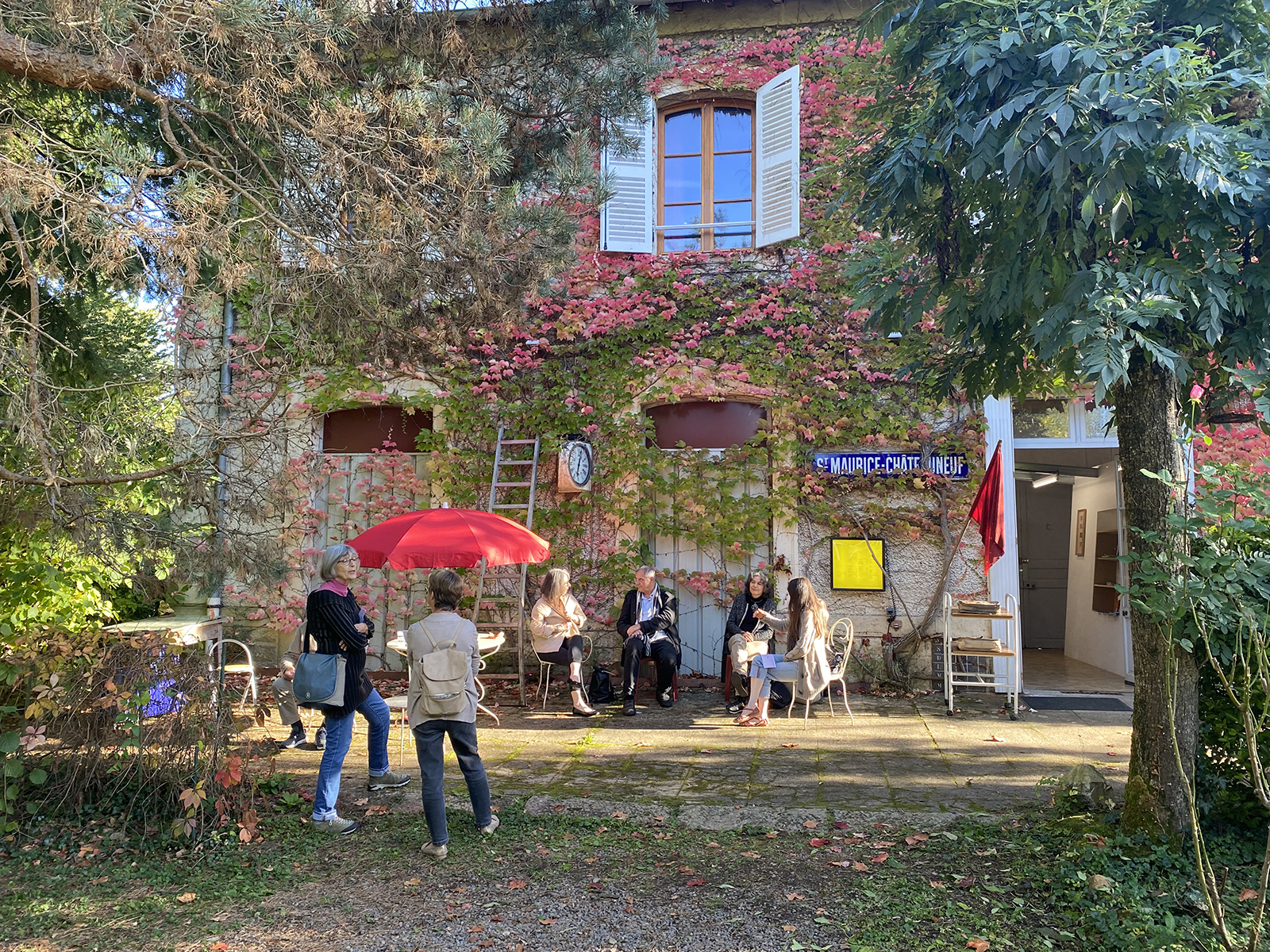
Since April 2018, the organisation has been based at the former railway station of Saint-Maurice-lès-Châteauneuf in the Saône-et-Loire department. Esox Lucius presents exhibitions, concerts performances and lectures at its historic venue, known as Le Quai (294M9). It organises artistic initiatives including residencies and workshops, while developing public contemporary art programmes for diverse audiences.
Anchored in its rural area, where nature plays a key role in everyday life, Le Quai (294M9) connects artists, local communities and the wider public. It works to create a dialogue between the local and the global, exploring the ecological, social, and poetic issues of our time.
For more than twenty years, the association has been a key cultural actor in the Bourgogne-Franche-Comté region, cultivating a loyal audience defined by its social and geographical diversity.
Esox Lucius receives support for its projects from the French Ministry of Culture (DRAC Bourgogne-Franche-Comté), the Bourgogne-Franche-Comté Regional Council, the Saône-et-Loire Departmental Council, and the Community of Towns council (Brionnais Sud Bourgogne). It is also a member of the regional contemporary art network Seize Mille, which allows it to collaborate with young artists and promote its projects to a wide audience.
Introducing Le Quai (294M9)
Le Quai (294M9) is located in the former railway station of a village with an exceptional setting. The interior design of the exhibition spaces was created by the designer Philippe Million, who adopted a particular sensitivity to the building’s origins and history. Artists and creators are not only offered a space for displaying artwork: we encourage them to engage with the building and its gardens, its history, and its rural context in their proposals. We consider Le Quai (294M9) as a space to be shared, open to the public and in direct dialogue with its experimental rural context. We ensure that the space is welcoming to all, that our programming is based on equality, inclusivity, and transgenerationality.
In organising solo and group exhibitions, Le quai (294M9) follows the recommendations of the French Association for the Development of Contemporary Art Centres (DCA). In the case of new artistic production, funding is allocated on a project-by-project basis according to the DCA reference framework.
Since the opening of Le Quai (294M9), the gardens have also served as exhibition spaces. Inaugurated in 2018 with Vincent Ganivet's work Double Hélicoïdale, the gardens are now in the process of becoming a designated bird refuge in partnership with La Ligue Protectrice des Oiseaux. We now seek to welcome works that foster and celebrate non-human life, with the goal of enriching human perception.
A place for artists in Residence
In addition to presenting four exhibitions every year, Le Quai (294M9) also organises artist residencies. Residencies vary in length and format and result in “in situ” production, solo exhibitions, production of new artworks, publication of artist editions. We also participate in the Pôle Position programme for emerging young artists organised by the Seize Mille contemporary art network. The team supports resident artists throughout their stay, considering their proposals carefully and adapting to their needs and wishes.
A place for educational & mediation projects
We develop and organise educational encounters adapted to school groups, from primary to high school, whether at Le Quai (294M9) itself, with exhibitions visits and specific mediation-projects, or at partner institutions (visual arts programme in secondary schools run with the Regional Council of Bourgogne-Franche-Comté).
We also offer events for the general public including mediation activities, creative workshops, yoga sessions, etc., allowing the public to experience art in a sensitive and creative way.
A place in the heart of a rural context
The Burgundy-Franche-Comté region is the largest rural region in France. Our institutional mission cannot ignore the territory we inhabit and care for. A unique feature of Le Quai (294M9) is its location in a village of 600 inhabitants in the Brionnais-Charolais region, surrounded by gardens. We encourage the artists who visit to consider this context in relation to their work.
The element of travel, particularly by train, has always been an inspiration for the invited artists and a way to connect with our audience. The rural setting and the possibilities offered by the gardens are also open to reflection: far from the fantasy of an isolated environment, we experience rurality as a dynamic and fluid space, shaped by human and professional activities, always in tune with the seasons. Le Quai (294M9) exists within this evolving environment, where the boundaries between city and countryside, work and leisure, nature and technology are intertwined, fragile, and complex.
Our programming makes these transformations and questions tangible. Through a cycle of exhibitions and public encounters, we aim to shape our space into a sharing and collective experience. It is together, with artists, audiences and staff, that we can imagine desirable futures.
Contact us
Le quai (294M9)
140, Rue de la gare
71740 Saint-Maurice-lès-Châteauneuf,
France
Tél. : (0033) 3 85 84 35 97
Portable : (0033) 7 68 02 24 17
esox@lequai.art